Who we are: Tire of Moto is run by ZENYARE (Qingdao Zhengya Rubber Industrial Co., Ltd.), a manufacturer of motorcycle tires and inner tubes. We're not a neutral test lab, and we haven't run tests for this article. Everything below comes from tire makers' own published guidance, with the sources at the end. We don't recommend any warmer brand, and there are no shopping links here.
If you ride on the road and you've booked your first track day, you've probably seen paddocks full of bikes wrapped in tire warmers and wondered whether you need a set too.
The honest answer is that it depends on the tire, not on whether you call yourself a street rider. Some tires are designed to be used with warmers. Others are designed to work without them. The tire makers say which is which, model by model. This guide sets out what Michelin, Pirelli and Bridgestone publish.
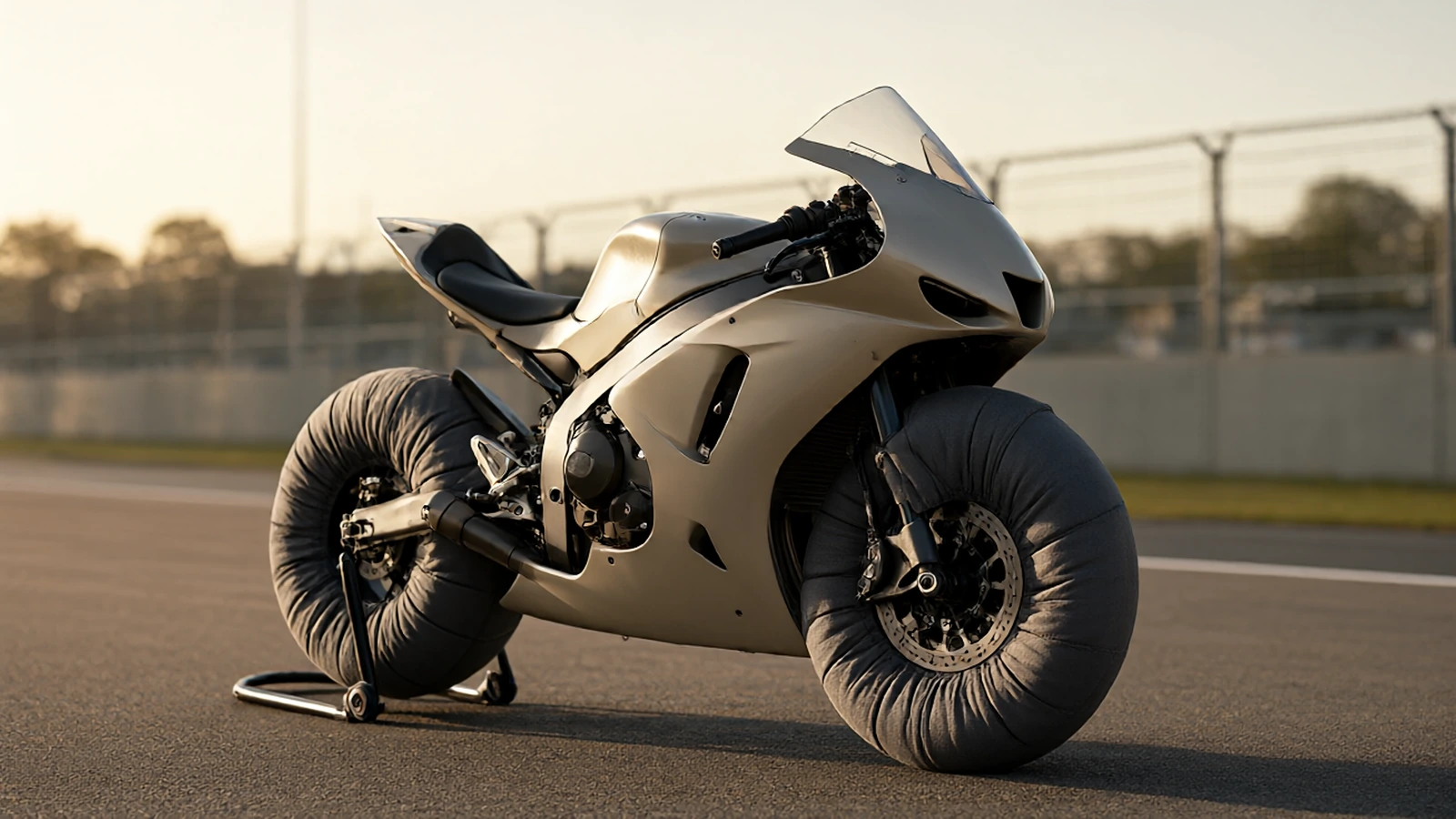
What tire warmers are for
Michelin explains it this way: "Circuit tires are designed to operate within a temperature window. This means that their performance is optimal only when this temperature is reached. But a tire is cold before it is run."
Warmers heat the tire before you ride. In Michelin's words, they "allow the tire to reach this temperature window more quickly and thus shorten the period during which the tire is less efficient."
Michelin also notes: "On very high performance tires used in competition, the use of tire warmers is mandatory."
So a warmer doesn't make a tire better. It gets a tire that needs heat to its working range before the first corner, rather than after a few laps.
Michelin: which tires need warmers
Michelin's track-day tire guide sorts its range by rider level and says, for each group, whether warmers are needed:
| Michelin tire | Road legal? | What Michelin says about warmers |
|---|---|---|
| Power Performance Slick Soft, Medium/Soft+, Power Performance Slick 24 | No | "Tire warmers must be used" |
| Power Slick 2 | No | "Does not require the use of tire warmers before driving" |
| Power Cup 2 | Yes | "Does not require the use of tire warmers before driving" |
| Power GP 2 | Yes | "Does not require the use of tire warmers before driving" |
| Power Cup Evo | Yes | "Does not require the use of tire warmers before driving" |
Michelin describes the Power Cup 2 as "designed for the track, approved for the road" and as a "street legal sportbike tire designed for 90% track use". The guide says the Power GP 2 is "oriented 50% for the track and 50% for the road."
On its track tire pressure page, Michelin adds that the Power Slick Evo, Power Cup Evo and Power RS "are designed to have a short warm-up time: use of tire warmers is not mandatory."
Michelin's warmer settings
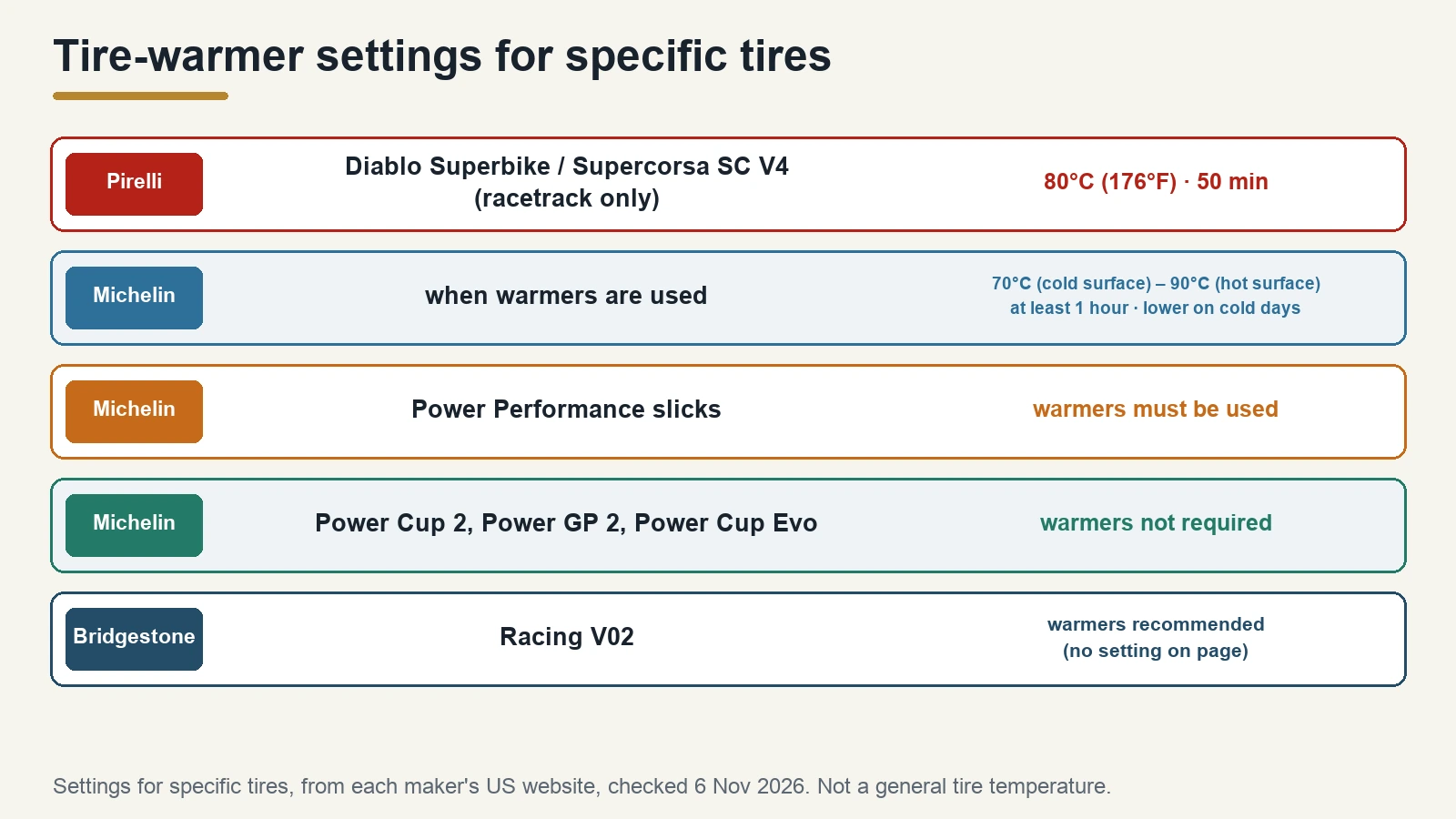
When warmers are used, Michelin's pressure page says they "should be used with temperatures of between 70°C (cold surface) and 90°C (hot surface) for at least 1 hour before the first ride."
It also warns against too much heat on a cold day: "The colder it is, the lower the temperature of the tire warmer should be in order to avoid the situation of tires cooling down while riding."
Pirelli: warmer instructions on its racetrack tires
Pirelli's US product pages include a "warmers usage" column in the pressure table for some tires:
| Pirelli tire | Use, as Pirelli lists it | Warmers usage on Pirelli's page |
|---|---|---|
| Diablo Superbike (slick) | Racetrack only | 50 mins @ 80°C (176°F), every listed size |
| Diablo Supercorsa SC V4 (treaded) | Racetrack only | 50 mins @ 80°C (176°F), every listed size |
| Diablo Supercorsa SP V4 | Road and racetrack | No warmer instructions on the page |
| Diablo Rosso IV | Road use | No warmer instructions on the page |
Pirelli says the Diablo Superbike carries an NHS (Not for Highway Service) marking, and "all NHS … motorcycle tires are only for pure racing and cannot be used on public roads."
For the Supercorsa SP V4, Pirelli gives separate track pressures "with warm tires" but no warmer setting. We didn't find warmer instructions on the Supercorsa SP V4 or Rosso IV pages. That isn't the same as Pirelli saying warmers are never used with them, so if you plan to use warmers with one of these, ask Pirelli or its racing dealer.
Bridgestone: "Tire warmers recommended"
Bridgestone's US page for the Battlax Racing V02, which it calls its "flagship non-DOT race tire", says: "Track Use Only. Tire warmers recommended." The page doesn't give a warmer temperature or time, so we haven't given one either. Ask Bridgestone or its race service for the setting.
So, do you need warmers as a street rider?
Use the tire on your bike to decide, not your riding label:
- Road-legal tires that the maker says don't need warmers, such as Michelin's Power Cup 2, Power GP 2 and Power Cup Evo: by Michelin's guidance, you can ride a track day without warmers.
- Racetrack-only tires with warmer instructions, such as Pirelli's Diablo Superbike and Supercorsa SC V4, or Michelin's Power Performance slicks: plan on warmers and follow the maker's setting. Michelin says warmers "must be used" with those slicks. These tires also can't be ridden on public roads, so you'd be trailering the bike anyway.
- Bridgestone's Racing V02: Bridgestone recommends warmers.
- Any other tire: check the maker's page or ask the maker. If it doesn't mention warmers, don't assume either way.
What about everyday road riding?
None of the pages we read tells road riders to use warmers on public roads. Michelin's FAQ describes the difference: "On a road, tires warm through normal mixed riding." On a track, it says, "the first laps should be deliberately progressive — gentle throttle, braking, and lean angles for the first few laps."
Riding a track day without warmers
If your tire doesn't call for warmers, Michelin's advice is about the first laps. It says "cold tires on a track provide dramatically less grip than warm ones", and calls the first corner of a session on cold tires "a high-risk situation." Build up throttle, braking and lean over the first few laps of every session, not just the first one of the day.
If your tires are new, they also need breaking in. Our guide to new motorcycle tire break-in covers what tire makers say about that.
Warmers and tire pressure
Warmers change how you set pressure, and Michelin is specific about it:
- Set pressure with the tire and rim at ambient temperature, before the warmers go on.
- "In no cases does the use of tire warmers make it possible to start with a lower pressure."
- Don't set pressure after the warmers have heated the tire. Michelin says the reading "will be artificially high and the tire will be underinflated when it cools."
- Before riding on the road again, return to the motorcycle manufacturer's cold road pressure.
"How hot should motorcycle tires be?"
The tire makers we read don't publish one working temperature for all motorcycle tires. What they publish are warmer settings for specific tires, like Pirelli's 80°C for 50 minutes for its racetrack tires, or Michelin's 70–90°C for at least an hour when warmers are used. Use the setting for the tire you have, and if the maker doesn't give one, ask them before using warmers.
FAQ
Are tire warmers worth it for a track day?
It depends on your tire. Michelin says its Power Cup 2, Power GP 2 and Power Cup Evo don't require warmers. Racetrack-only tires such as Pirelli's Diablo Superbike come with warmer settings, and Michelin says warmers must be used with its Power Performance slicks.
Can I use tire warmers on road tires?
Check with the tire maker. The Pirelli road tire pages we read (Diablo Rosso IV, Supercorsa SP V4) give no warmer instructions. Michelin's pressure rules for warmers apply whenever warmers are used: set pressure cold, before heating.
What temperature should tire warmers be set to?
Use the setting for your tire. Pirelli lists 50 minutes at 80°C (176°F) for the Diablo Superbike and Supercorsa SC V4. Michelin's pressure page says 70°C to 90°C for at least an hour before the first ride, and a lower setting on cold days.
Do I need warmers to ride on the street?
None of the tire maker pages we read recommends warmers for public roads. Michelin says that on a road, "tires warm through normal mixed riding."
Should I lower my pressure if I use warmers?
No. Michelin says warmers never make it possible to start with a lower pressure. Set it at ambient temperature before the warmers go on.
Related guides
Sources
| Source | URL | Checked |
|---|---|---|
| Michelin USA, How to choose the best motorcycle tires for track days? (10 August 2026) | https://www.michelinman.com/motorcycle/tips-and-advice/choose-tires/tires-motorcycle-track-days | 20261106 |
| Michelin USA, Motorcycle tire pressure on track (updated 23 July 2026) | https://www.michelinman.com/motorcycle/tips-and-advice/tips-to-take-care-of-motorcycle-tires/tire-pressure-on-track | 20261106 |
| Michelin USA, Michelin Power Cup 2 | https://www.michelinman.com/motorcycle/tires/michelin-power-cup-2 | 20261106 |
| Pirelli USA, Diablo Superbike (pressure table, warmers usage, NHS) | https://www.pirelli.com/tires/en-us/motorcycle/catalog/product/diablo-superbike | 20261106 |
| Pirelli USA, Diablo Supercorsa SC V4 (pressure table, warmers usage) | https://www.pirelli.com/tires/en-us/motorcycle/catalog/product/diablo-supercorsa-v4-sc-new | 20261106 |
| Pirelli USA, Diablo Supercorsa SP V4 | https://www.pirelli.com/tires/en-us/motorcycle/catalog/product/diablo-supercorsa-v4-sp-new | 20261106 |
| Pirelli USA, Diablo Rosso IV | https://www.pirelli.com/tires/en-us/motorcycle/catalog/product/diablo-rosso-iv | 20261106 |
| Bridgestone USA, Battlax Racing V02 | https://tires.bridgestone.com/en-us/tires/motorcycle/battlax/racing-v02 | 20261106 |