# Mousse Inserts vs Tubes for Off-Road: Pros and Cons
Who we are: Tire of Moto is run by ZENYARE (Qingdao Zhengya Rubber Industrial Co., Ltd.), a manufacturer of motorcycle tires and inner tubes that also makes mousse inserts. So we make both of the things this article compares. We're not a neutral test lab, and we haven't run our own tests for this article. The figures below come from a tire maker's published guidance, with the source at the end.
If you ride enduro, rally or motocross, flats are part of the sport. A tube can be pinched on a rock, and a thorn can end your day. A mousse insert is the main alternative: a foam ring that takes the place of the tube and the air. It solves the puncture problem, but it brings its own limits on speed, road use, heat and lifespan.
This guide sets out what each option does, what the maker's documentation says, and how to decide.
What a mousse insert is
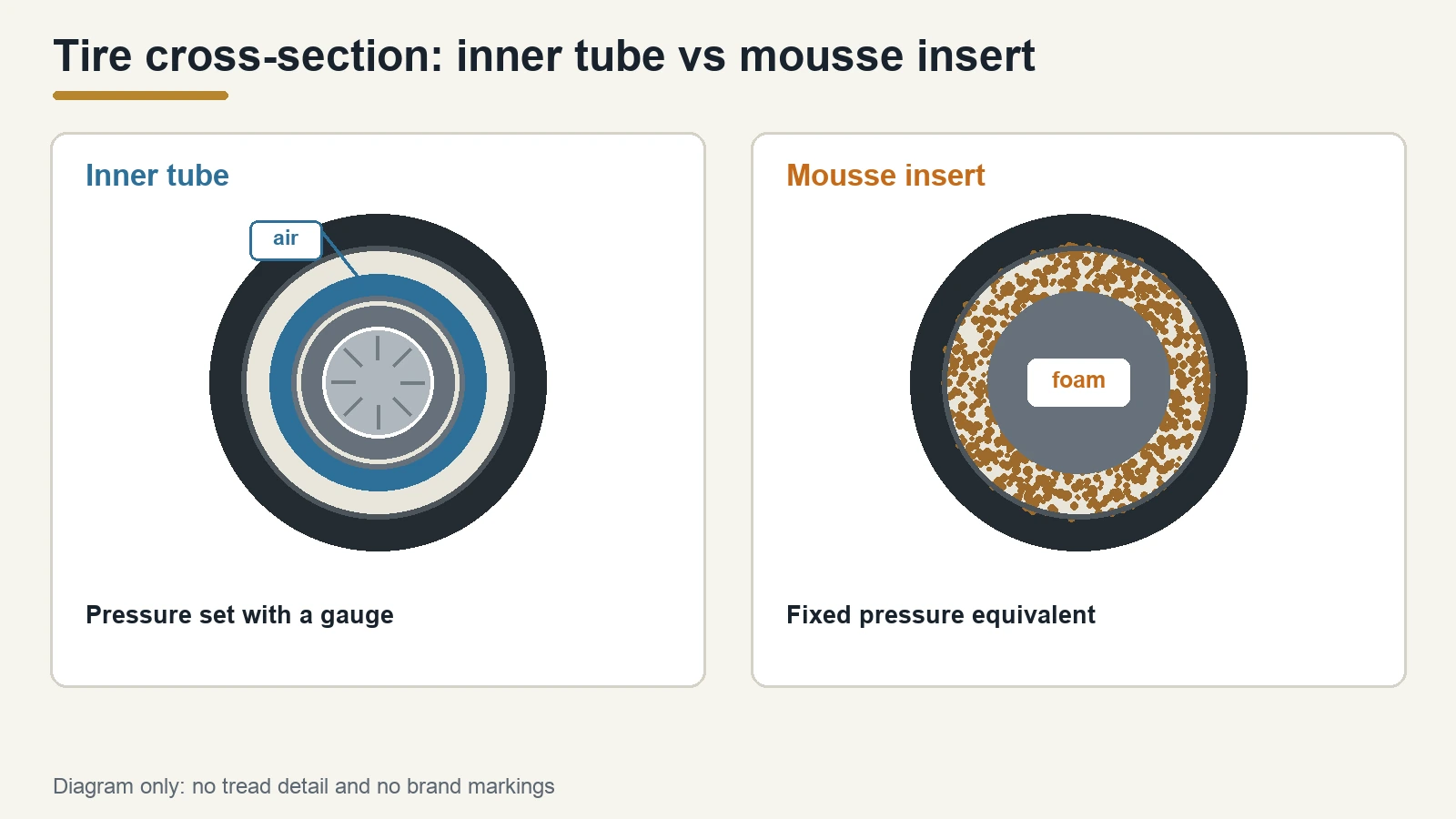
Michelin describes a mousse as "a foam insert that replaces the inner tube and air in an off-road tire." Instead of air pressure, it gives the tire a consistent "pressure equivalent" whether or not the tire is punctured. In Michelin's words, "a punctured tire with a mousse continues to function."
That's why mousses are common in competition, where stopping to fix a flat can cost the race. Michelin adds that mousses "are not a universal substitute for inner tubes and require the correct combination of tire and mousse size."
What an inner tube does
An off-road tube holds air inside the tire, and you set the pressure with a gauge and pump. That means you can change it for the terrain. Michelin notes that slightly lower pressure on loose or soft ground increases the contact area and can improve grip, and that harder, rockier surfaces typically need slightly higher pressure to protect the tire and rim.
The trade-off is what happens when pressure goes too low. Michelin lists two main risks:
- Pinch flats: the tube gets pinched between the tire and rim when the tire compresses against a hard obstacle.
- Rim damage: the rim strikes rocks or hard edges that the under-pressured tire can't cushion.
For tubes, Michelin's advice is to stay "within the range specified for the tire and terrain," lower than road pressure but "not as low as possible."
What the maker says about a mousse: the limits
Here's what Michelin publishes for its own Bib Mousse. These figures apply to that product, used as Michelin specifies. If you use another mousse, follow its maker's instructions instead.
| Topic | What Michelin says about Bib Mousse |
|---|---|
| Pressure equivalence | 0.8–1.0 bar (11.6–14.5 psi) |
| Tires | "Designed exclusively for MICHELIN brand tires" |
| Maximum speed | 130 km/h (80 mph) |
| Road use | Marked NHS (Not for Highway Service); "it should not be used on the public highway" |
| Storage heat | Not kept long term above 30°C; best to avoid temperatures above 40°C altogether |
| Lifespan | Maximum of 6 months after fitting; varies with intensity of use and discipline, much shorter for motocross than for enduro |
| Fitting | Apply Michelin gel every time the mousse is fitted or removed, new or used |
| Riding | Before a fast stage, warm up the tire and mousse progressively at a moderate speed |
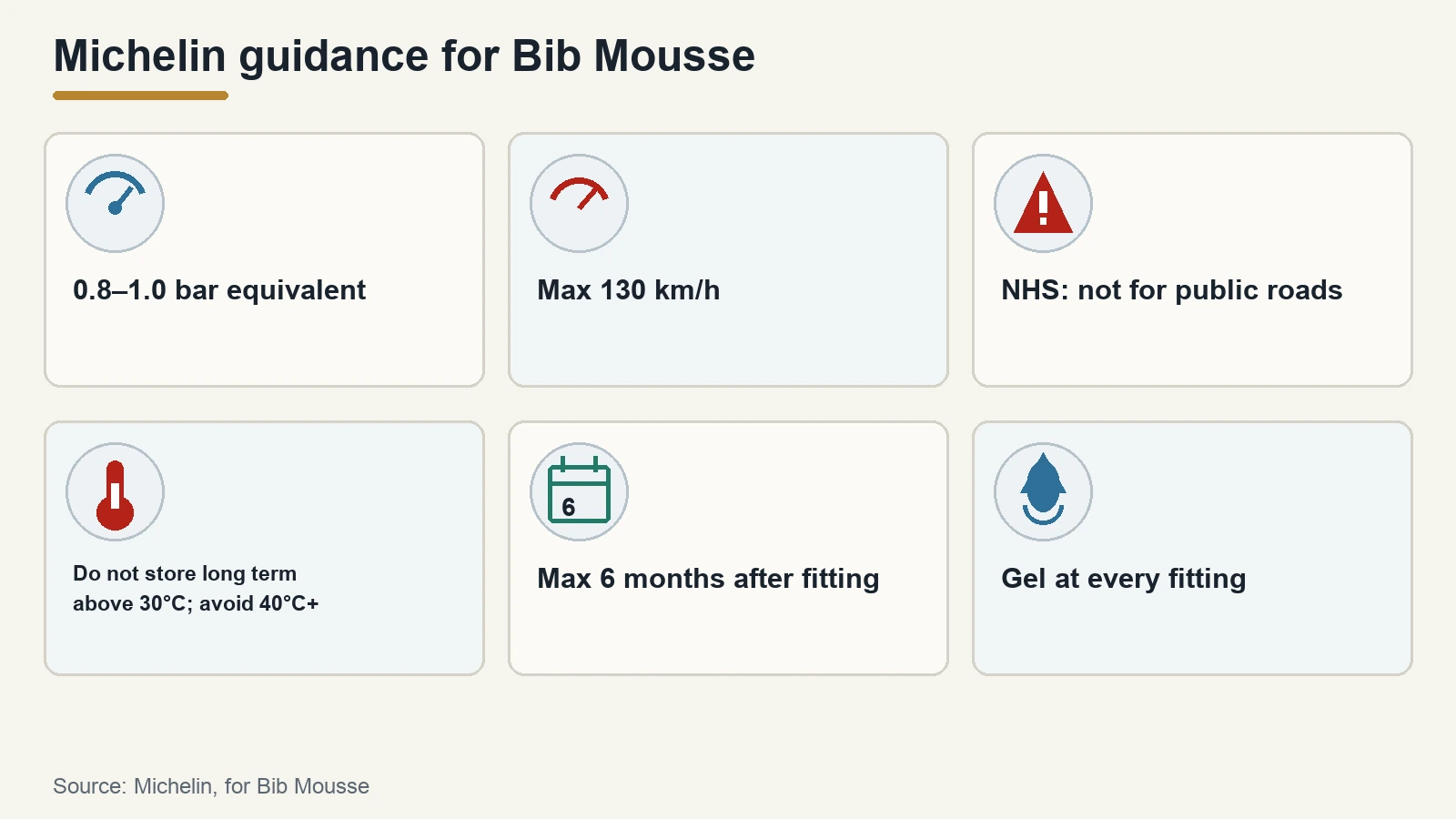
Three things stand out.
For Michelin's Bib Mousse, it's an off-road product. The NHS marking and the 130 km/h limit mean that product isn't for riding to the trailhead on the highway. For another mousse, check its own road-use and speed limits.
It wears out, even if you never get a flat. Michelin gives a maximum of six months after fitting and says it can be much shorter in motocross. A tube doesn't have a published service life like that.
Heat matters. Michelin links the gel to avoiding "excessive overheating," recommends a progressive warm-up before fast stages, and gives storage temperature limits.
Pros and cons side by side
| Mousse insert | Inner tube | |
|---|---|---|
| Puncture | The tire keeps working when punctured | A puncture or pinch means a flat |
| Pressure | Fixed pressure equivalence from the maker (Bib Mousse: 0.8–1.0 bar) | You set it with a gauge for the terrain |
| Too-low pressure risk | No air pressure to drop | Pinch flats and rim damage if run too low |
| Road use | Bib Mousse: NHS, not for public highways | Follow the tire's road marking and pressures |
| Speed | Bib Mousse: maximum 130 km/h | Follow the tire's speed rating |
| Service life | Bib Mousse: maximum 6 months after fitting, shorter in MX | No fixed service life published by the maker we cite |
| Heat and storage | Avoid long storage above 30°C; avoid above 40°C | No comparable limit in the source we cite |
| Fitment | Needs the correct tire and mousse size combination | Needs the right tube size and valve for the tire and rim |
Everything in the mousse column comes from Michelin's page. The tube column only contains what that page says about tubes plus general sizing; we have not added figures without a source.
How to decide
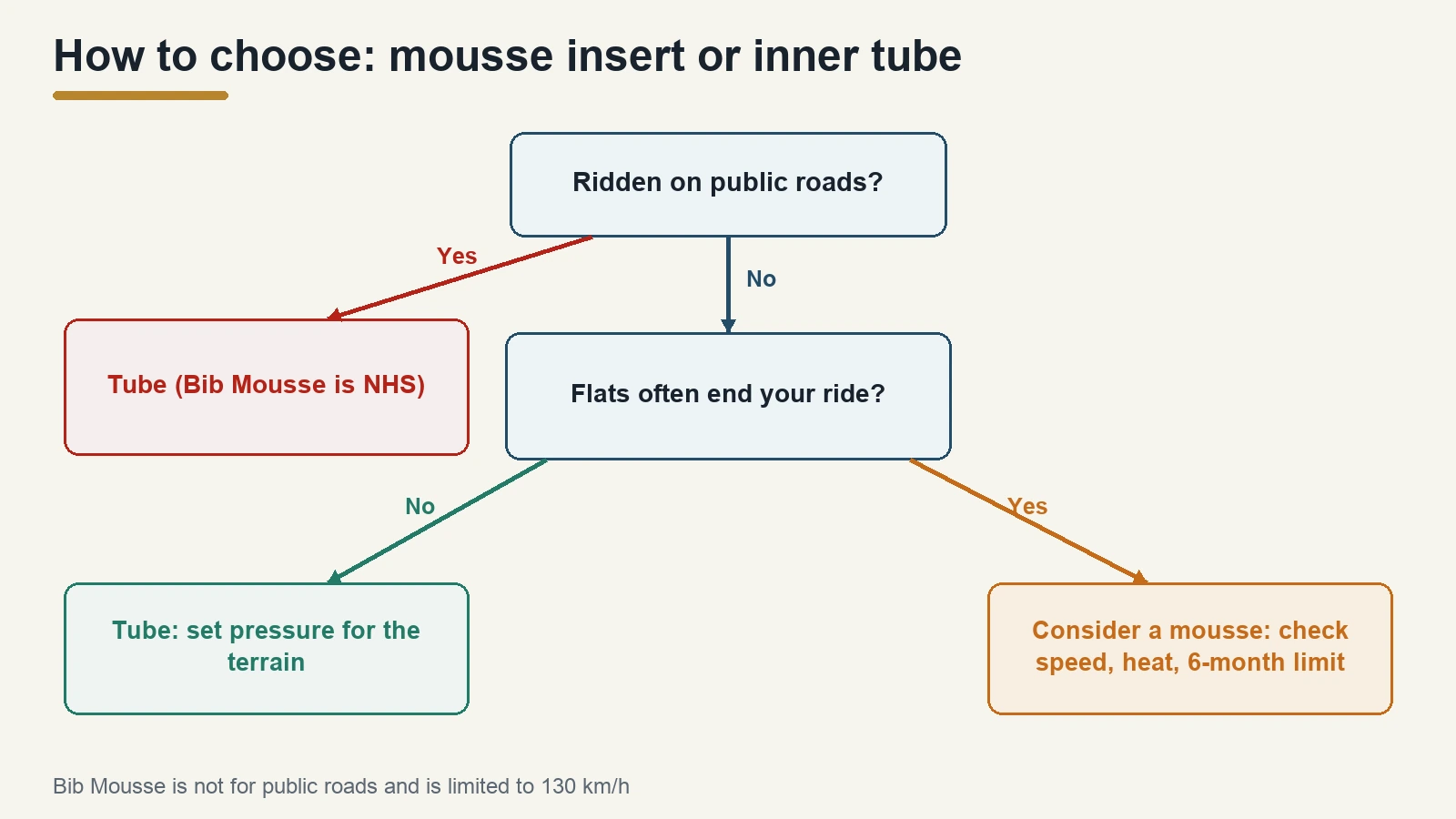
Ask these questions in order.
- Is the bike ridden on public roads? If yes, Bib Mousse is out: Michelin says it should not be used on the public highway. Look at the documentation of any other mousse before assuming it's different.
- How often do you get flats? If punctures regularly end your rides or races, a mousse removes that problem. If flats are rare for you, the Bib Mousse example's six-month limit and fixed pressure may cost more than they save; check another mousse's own specifications.
- Do you change pressure for different terrain? A tube lets you. A mousse gives the pressure equivalence its maker specifies.
- Which discipline? Michelin says a mousse's life is much shorter in motocross than in enduro. Plan to replace it accordingly.
- Can you store it cool? If your workshop gets above 30°C for long periods, a spare mousse stored there is outside Michelin's guidance.
Getting the size right either way
For a mousse, the tire size and mousse size have to match the combination the maker specifies. For a tube, match the tube size to the tire size on the sidewall and the valve to your rim. Our motorcycle tire size chart helps you read sizes, and our guide on how to choose motorcycle tires covers picking the tire first.
If the tire won't sit evenly on the rim after fitting either one, see our guide to a motorcycle tire bead that won't seat.
FAQ
What is a motorcycle mousse insert?
A foam insert that replaces the inner tube and air in an off-road tire. It gives a consistent pressure equivalent, and the tire keeps working if it is punctured.
How long does a mousse insert last?
For its Bib Mousse, Michelin says a maximum of 6 months after fitting, and much shorter for motocross than for enduro. Other mousses have their own limits; check the maker's instructions.
Can I use a mousse on the road?
Not a Bib Mousse. Michelin marks it NHS (Not for Highway Service) and says it should not be used on the public highway. Its maximum speed is 130 km/h.
What pressure does a mousse equal?
Michelin gives 0.8–1.0 bar (11.6–14.5 psi) as the pressure equivalence for Bib Mousse in Michelin tires. You can't adjust it with a pump the way you can with a tube.
Is a mousse always better than a tube off-road?
No. It removes flats, but it has speed, road-use, heat and lifespan limits, and it must match the tire. A tube lets you set pressure for the terrain but can pinch-flat if run too low.
Sources
| Source | URL | Checked |
|---|---|---|
| Michelin USA, "Motorcycle Off-Road Tire Pressure & Michelin Bib Mousse" (mousse definition, pressure equivalence, NHS and 130 km/h, storage temperatures, 6-month maximum, gel, warm-up, Michelin-tires-only, tube pressure risks) | https://www.michelinman.com/motorcycle/tips-and-advice/tips-to-take-care-of-motorcycle-tires/tire-pressure-off-road | 20261104 |
| Tire of Moto disclosure (who runs this site) | https://tireofmoto.com/disclosure/ | 20261104 |