Look up a conversion chart and you'll see 3.00-18 and 90/90-18 on the same line. Look up the same chart for a 2.75-18 and you may find 90/90-18 there too. Two different inch sizes can't both be exactly the same metric size, and that's the clue: these charts list approximate matches, not identical tires.
This guide does the math for both sizes, shows what a manufacturer's conversion chart actually says, and explains what to check before you fit one in place of the other.
If you need a refresher on what the numbers on a motorcycle tire mean, see our guide to how motorcycle tire sizes work.
Two ways of writing a tire size
The metric size: 90/90-18
A metric size like 90/90-18 has three numbers. Mitas's guide to tire markings describes them as:
- 90: the nominal section width, in millimeters.
- 90: the aspect ratio, "H/SW (in %)", meaning the sidewall height as a percentage of the section width.
- 18: the nominal rim diameter, in inches.
So a 90/90-18 is nominally 90 mm wide, with a sidewall 90% as tall as it is wide, on an 18-inch rim.
The inch size: 3.00-18
An inch size like 3.00-18 has only two numbers:
- 3.00: the nominal section width, in inches.
- 18: the nominal rim diameter, in inches.
In Mitas's examples of inch-style sizes, the marking gives the section width and the rim diameter and nothing else. There's no aspect ratio in the size. The size alone doesn't tell you how tall the sidewall is.
That missing number is the main reason an inch size and a metric size can't be converted exactly. You can convert the width. You can't convert a height that was never written down.
The math, step by step
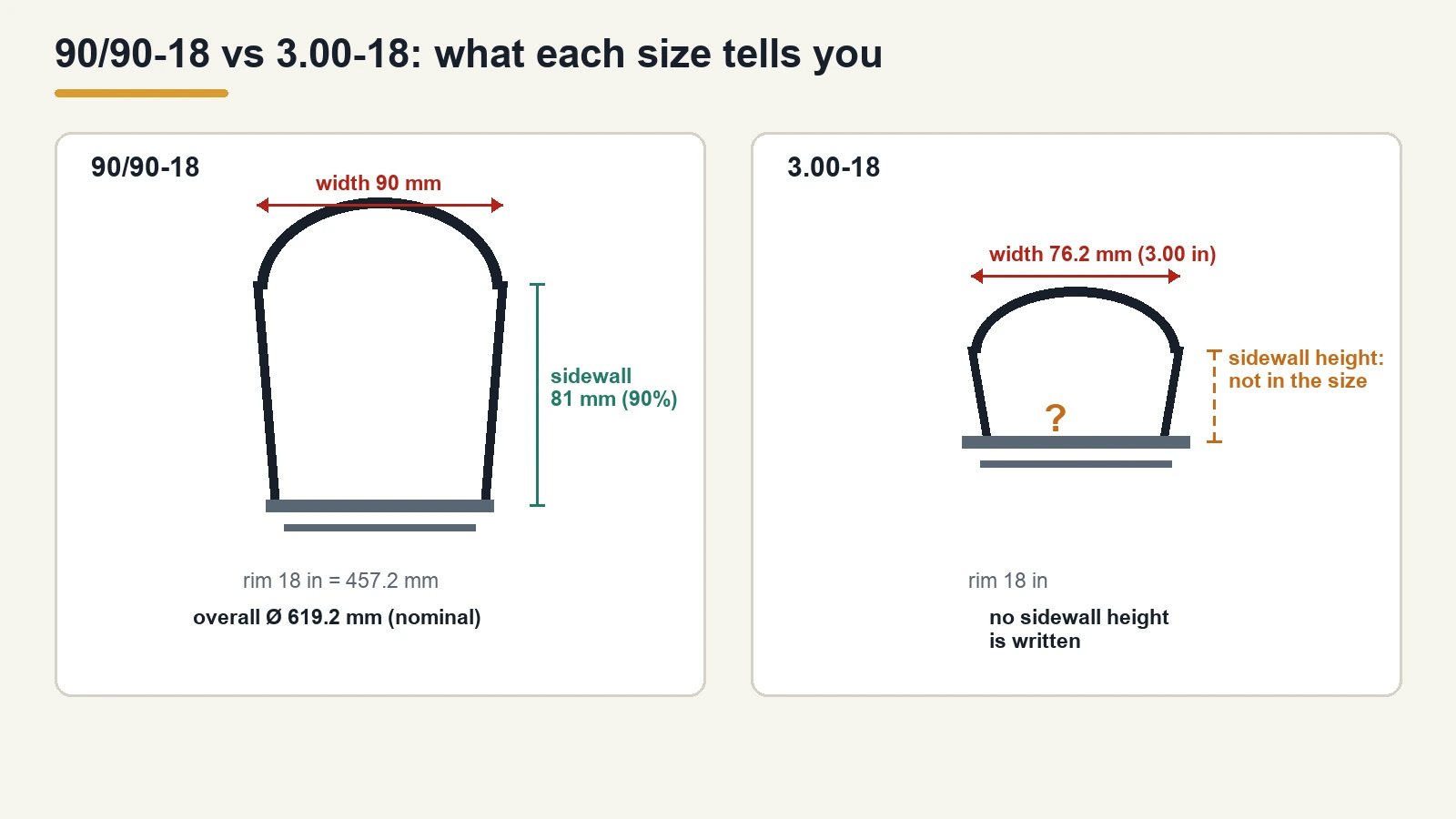
Here's what you can work out from the sizes themselves. Every number below is calculated from the size markings, so they are nominal values: the real tire you buy will measure a little differently depending on the model and the rim it's mounted on.
Step 1: convert the widths
One inch is 25.4 mm.
| Size | Width in inches | Width in mm |
|---|---|---|
| 2.75-18 | 2.75 | 69.85 |
| 3.00-18 | 3.00 | 76.2 |
| 90/90-18 | 3.54 | 90 |
On paper, a 90/90-18 is 13.8 mm wider than a 3.00-18, and about 20 mm wider than a 2.75-18. That's a big gap for two sizes that appear on the same line of a chart.
Step 2: work out the sidewall height of the metric tire
Sidewall height = width × aspect ratio ÷ 100
For 90/90-18: 90 × 90 ÷ 100 = 81 mm.
For the 3.00-18 you can't do this step, because there's no aspect ratio to multiply by.
Step 3: work out the overall diameter
Overall diameter = rim diameter + 2 × sidewall height
The rim is 18 × 25.4 = 457.2 mm. For the 90/90-18:
457.2 + 2 × 81 = 619.2 mm nominal overall diameter, or about 1,945 mm around (diameter × π).
What the missing height does to the answer
To show how much that unknown sidewall height matters, here's what a 3.00-18 would measure if its sidewall were 100%, 90% or 80% of its width. This is an illustration of the math, not tire data. We couldn't find a tire maker's published dimensions for a 3.00-18, and different models won't all match one number.
| If a 3.00-18 sidewall were… | Sidewall height | Overall diameter | Smaller than a 90/90-18 (619.2 mm) by |
|---|---|---|---|
| 100% of its width | 76.2 mm | 609.6 mm | about 1.6% |
| 90% of its width | 68.6 mm | 594.4 mm | about 4.0% |
| 80% of its width | 61.0 mm | 579.1 mm | about 6.5% |
The point isn't any single row. It's that the answer moves by several percent depending on a number the size doesn't give you. A change in overall diameter changes how far the bike travels per wheel turn, so it also changes what your speedometer shows and how the tire sits in the fork or swingarm.
What a conversion chart really says
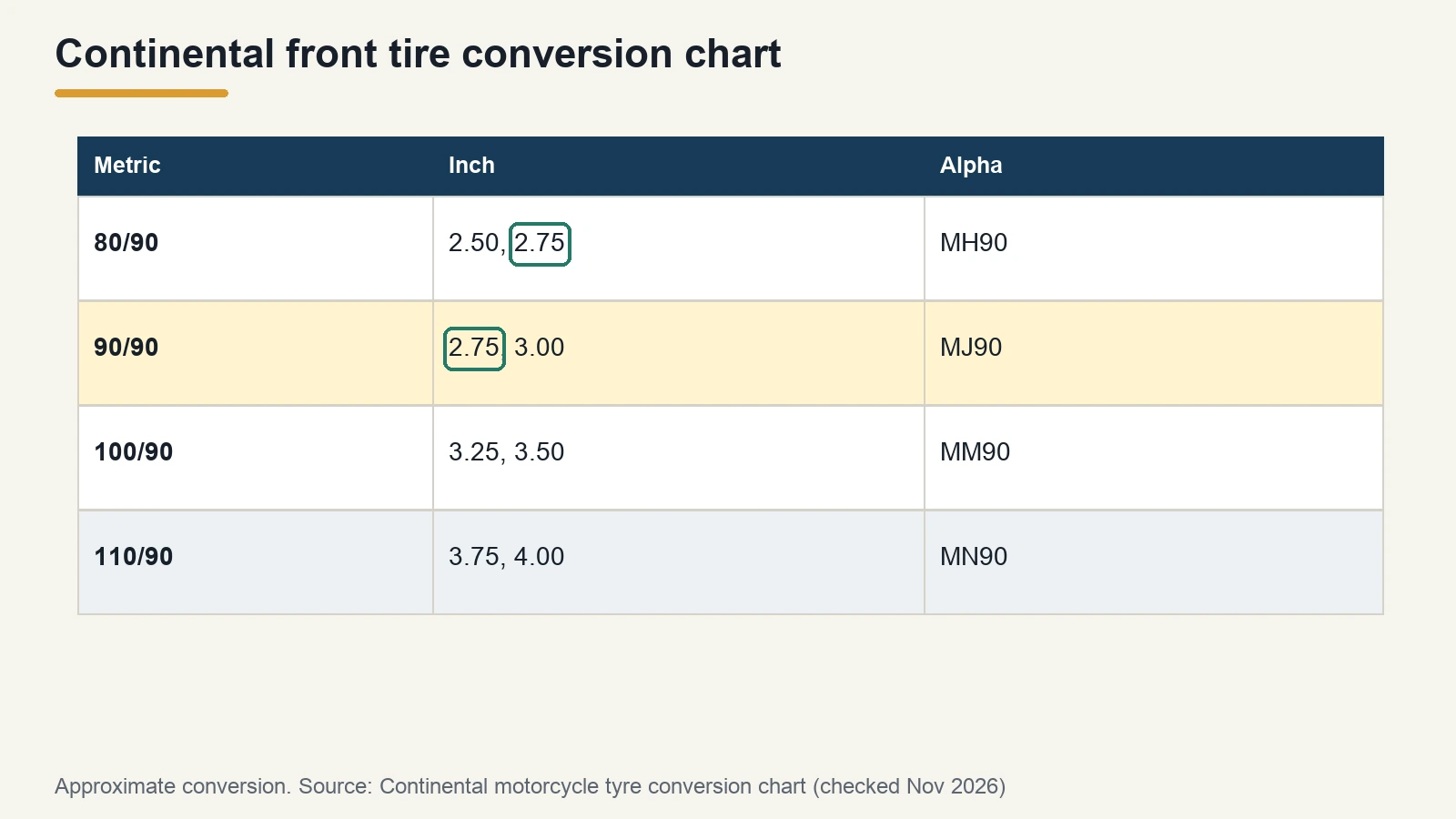
Tire makers do publish inch-to-metric charts. Continental's chart for motorcycle tires is a good example, and it's honest about what it is. It introduces the table as an "approximate" conversion of metric to inch and alpha sizes.
Here's the front-tire part of Continental's chart:
| Metric | Inch | Alpha |
|---|---|---|
| 80/90 | 2.50, 2.75 | MH90 |
| 90/90 | 2.75, 3.00 | MJ90 |
| 100/90 | 3.25, 3.50 | MM90 |
| 110/90 | 3.75, 4.00 | MN90 |
A few things stand out:
- Each metric size covers two inch sizes. 90/90 is listed against both 2.75 and 3.00, which are 6.35 mm apart in width.
- The same inch size can appear twice. 2.75 shows up next to 80/90 and next to 90/90.
- Front and rear aren't the same. In the rear-tire part of the same chart, 110/90 is listed against 4.00 and 4.25, while in the front part it's listed against 3.75 and 4.00.
None of this means the chart is wrong. It means a chart is a starting point for finding sizes in the same family, not proof that two tires are interchangeable.
Continental adds a warning right under the heading:
"Please note that with any difference from original sizes the rolling circumference changes and the tyre clearance needs to be checked. Pay attention to the load index and adjust inflation pressure of the tyre. Please follow the instructions of the vehicle manufacturer."
That's the tire maker telling you, in its own words, that switching between these sizes is a change, not a like-for-like swap.
What to check before fitting one in place of the other
1. What your motorcycle maker approves
Start with the sizes in your owner's manual or on the bike's tire label. Dunlop's guidance is short and clear: only use a size approved by the motorcycle manufacturer or tire maker. Dunlop says a change should only be made "with the approval of the motorcycle or tire manufacturer."
If your manual lists 3.00-18 and the shop only has 90/90-18, ask the tire maker or the bike maker whether that size is approved for your model. Don't treat the chart as the approval.
2. Clearance
A metric tire that's nominally 13.8 mm wider may rub on a fork brace, a mudguard or a chain. Continental's note says "the tyre clearance needs to be checked." Check with the wheel fitted and the suspension compressed, not just with the bike on a stand.
3. Rim width
The tire maker lists which rim widths each tire size is designed for. A wider tire on a narrow rim changes its shape. Our guide to rim width vs tire width explains where to find those rim widths.
4. Load index and speed rating
Two tires in "equivalent" sizes can carry different load indexes and speed symbols. Continental's note says to "pay attention to the load index." The replacement should meet what your owner's manual asks for.
5. Inner tube
If the tire is tube-type, the tube has to match the tire you're actually fitting, so check the size on the tube's label against the new tire, not the old one. Our tube buying checklist covers size, valve type and stem length.
6. Pressure
Continental also says to "adjust inflation pressure of the tyre." Use the pressure your bike maker or the tire maker gives for the size you fit, not the number you used for the old size.
Converting widths yourself
If you just need the width in the other unit, the math is simple:
- inches × 25.4 = millimeters
- millimeters ÷ 25.4 = inches
Our tire width converter does this for you. Remember that it only converts the width; it can't tell you the sidewall height of an inch-sized tire, or whether a size fits your motorcycle. For the full set of fitting checks, see how to choose motorcycle tires.
FAQ
Is 3.00-18 the same as 90/90-18?
Not exactly. Continental's conversion chart lists 90/90 as an approximate match for both 2.75 and 3.00 inch front sizes. On paper, a 90/90-18 is 90 mm wide and a 3.00-18 is 76.2 mm wide, and the inch size doesn't state a sidewall height at all.
Can I put a 90/90-18 on a bike that came with 3.00-18?
Only use a size approved by the motorcycle manufacturer or tire maker. Dunlop says a change should only be made "with the approval of the motorcycle or tire manufacturer." Then check clearance, rim width, load index and pressure.
What is the metric equivalent of a 2.75-18?
Continental's chart lists 2.75 against both 80/90 and 90/90 for front tires. That's an approximate family, not an exact conversion. Your owner's manual or the tire maker's fitment list decides which size is right for your bike.
How do I work out the overall diameter of a metric tire?
Multiply the width by the aspect ratio and divide by 100 to get the sidewall height. Then add twice the sidewall height to the rim diameter in millimeters (inches × 25.4). For 90/90-18: 457.2 + 2 × 81 = 619.2 mm.
Why can't I calculate the diameter of a 3.00-18?
Because an inch size only gives the width and the rim diameter. Without the sidewall height, you need the tire maker's published dimensions for that specific tire model.
Sources
| Source | URL | Checked |
|---|---|---|
| Continental, Conversion Chart Motorcycle Tyres Sizes (Metric – Inch – Alpha, with fitting note) | https://www.continental-tires.com/au/en/tyre-knowledge/conversion-chart-motorcyle-tyres/ | 20261102 |
| Mitas, Markings and definitions (tire size marking: aspect ratio H/SW, inch-style sizes) | https://www.mitas-tires.com/en/tech/markings-and-definitions | 20261102 |
| Dunlop Motorcycle Tires, FAQ (size changes need motorcycle or tire maker approval) | https://www.dunlopmotorcycletires.com/about/faq | 20261102(引文照任务卡 346,本轮该站拦截自动访问,未重开) |
| Our calculations: Python, run 2 November 2026 | — | 20261102 |