You've got the new tire on the rim, you start adding air, and one side just won't pop into place. Or it seats, but the wheel wobbles when you spin it. It's one of the most common snags when fitting a motorcycle tire yourself, and the temptation is to keep adding air until something gives.
Don't. Over-inflating a tire to force the bead is exactly how mounting injuries happen. This guide covers what the tire makers actually publish about seating the bead, the usual reasons it won't seat, and when it's time to stop and hand the wheel to a tire shop.
First, a safety note
Dunlop's safety advisory on mounting street tires opens with a blunt warning: "Danger: Only specially trained persons should mount tires. Improper mounting can cause tire explosion and serious injury."
Michelin's motorcycle FAQ makes a similar point about road tires: "we do not recommend changing a motorcycle tire for road use as it is a more complex procedure that requires wheel balancing." It says you can do it yourself for off-road riding "if you have the necessary tools."
So if you're fitting a road tire at home, know that the tire makers would rather you didn't. If you're going ahead anyway, follow their procedures exactly. The steps below come from them.
What "seating the bead" means
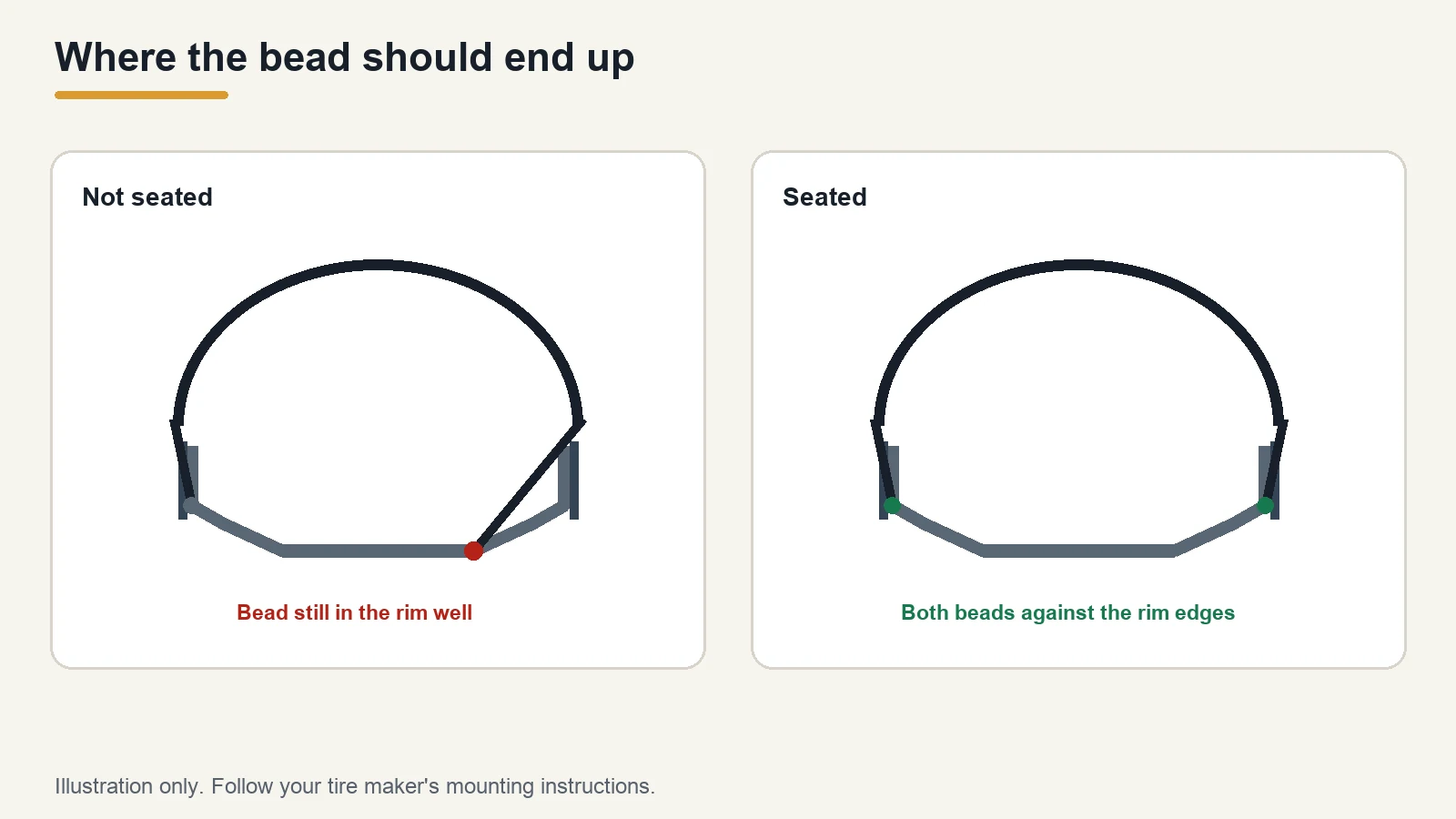
The bead is the stiff edge of the tire that sits against the rim. When you inflate a freshly fitted tire, air pressure pushes the bead outward from the centre of the rim onto its seat against the rim flange, on both sides. A seated bead holds the tire in the right position all the way round. An unseated bead means the tire isn't sitting evenly on the rim.
Dunlop's check is simple: "Spin wheel to check bead seating and alignment."
Why a bead won't seat
The tire makers' instructions point to a few usual causes. Work through them before reaching for more air.
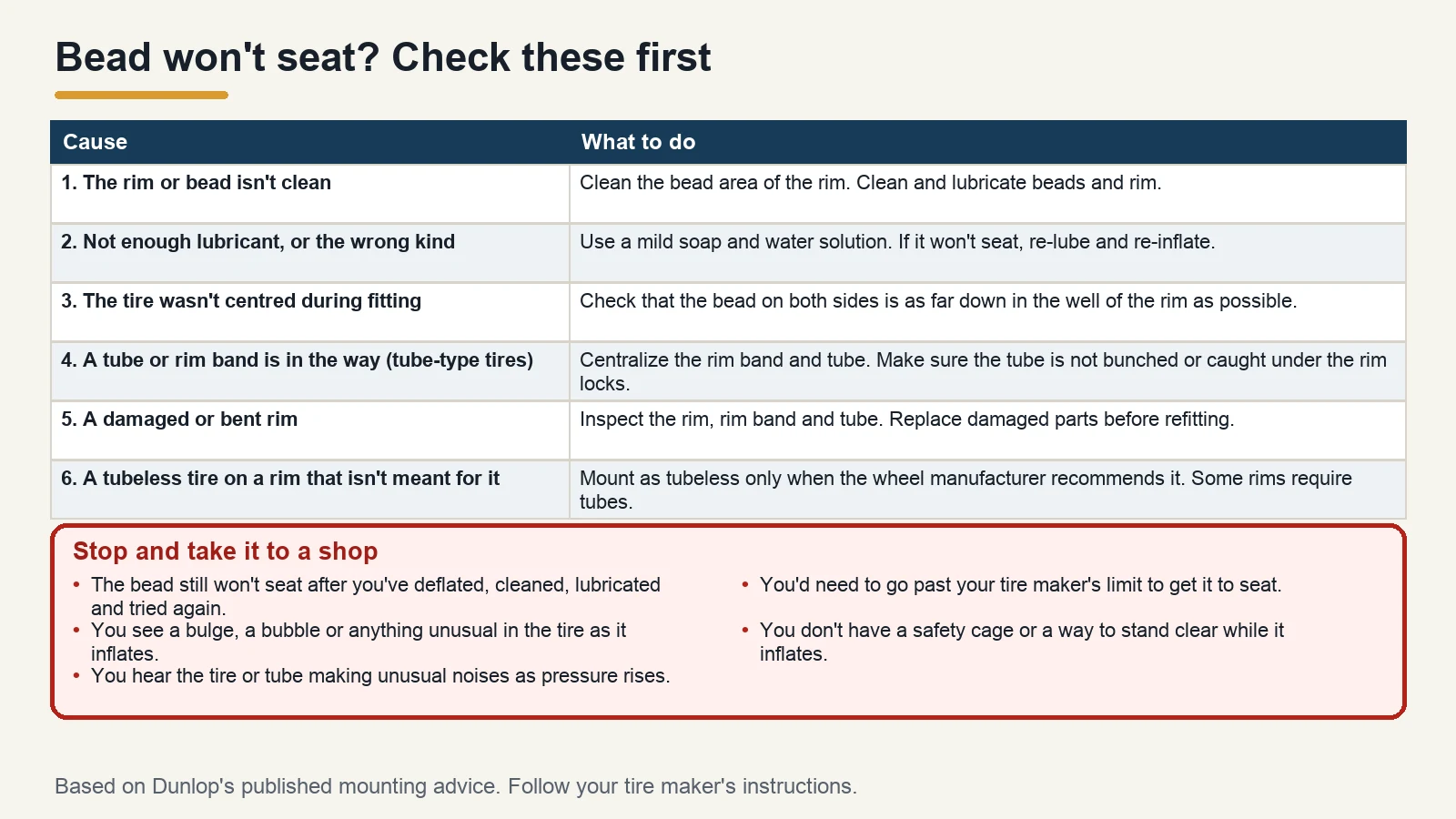
1. The rim or bead isn't clean
Dirt, old rubber or corrosion on the rim's bead seat creates friction and stops the bead sliding into place. Dunlop's off-road procedure says: "Clean the bead area of the rim." Its street procedure says: "Clean and lubricate beads and rim."
2. Not enough lubricant, or the wrong kind
The bead needs to slide over the rim as it seats. Dunlop's off-road steps say to "Lube the bead with a mild soap and water solution." If the bead won't seat, the same procedure says to "Re-lube the bead areas with soapy solution and re-inflate until seated properly."
Dunlop also lists what never to use: "Never use a volatile substance or rubber donut to aid bead seating."
3. The tire wasn't centred during fitting
If part of the bead is stuck high on the rim while the rest is down, it can't seat evenly. When fitting, Dunlop's off-road steps say: "With each bite, check that the bead of both sides of the tire is as far down in the well of the rim as possible."
4. A tube or rim band is in the way (tube-type tires)
On a tube-type wheel, a twisted tube or a rim band that's slipped can stop the tire sitting properly. Dunlop's street advisory says: "Centralize rim band and tube to prevent pinching if tube-type rim." Its off-road steps add: "Be sure the tube is not bunched up in any area or caught under the rim locks."
5. A damaged or bent rim
Dunlop notes that "Bent rims may cause wheel wobble, bead unseating and, in the case of tubeless tires, gradual air loss." It also advises: "Inspect the rim, rim band and tube, and replace any of these components if they are damaged before refitting the tire."
6. A tubeless tire on a rim that isn't meant for it
Not every rim can run tubeless. Dunlop says: "Mount tires as tubeless only when the wheel manufacturer recommends it. Some spokeless rims require tubes." Our article on how motorcycle tire sizes work explains the TT and TL markings.
How much pressure is too much?
There's no single safe number for every tire, and you shouldn't trust one you read on a forum. Follow the instructions of the maker of your tire.
As an example of what a tire maker publishes, Dunlop's advisory for its street tires says: "Never inflate above 40 psi to seat beads." It adds: "If the beads do not seat by 40 psi, deflate and repeat above procedures." That's Dunlop's instruction for its own street tires. Other makers set their own limits, so check the instructions for the tire you're fitting.
For off-road tires, Dunlop's procedure gives no number but the same principle: "Should the beads not seat properly, do not overinflate."
Also keep in mind what the pressure on the sidewall means. Dunlop's FAQ says: "The pressure noted on the sidewall of the tire is a maximum for that tire and may not match the recommended pressure for your motorcycle." It's neither a seating pressure nor a riding pressure.
Setting up safely
Dunlop's street advisory lists precautions for inflating to seat the bead:
- "Lock assembly on mounting machine or place in safety cage before inflating to seat beads."
- "Wear approved eye protection."
- "Stand back with no part of your body within the perimeter of the assembled tire and rim."
- "Use extension gauge and hose with clip-on air chuck."
If you don't have a way to do these things, that alone is a good reason to take the wheel to a shop.
Step by step when the bead won't seat
- Let all the air out. Don't keep adding pressure.
- Check the rim and bead for dirt, damage or a pinched tube.
- Re-lubricate the bead areas with a mild soap and water solution.
- Push the bead down into the rim's well around the whole tire, so it's centred.
- Re-inflate with the safety precautions above, staying within your tire maker's limit.
- Spin the wheel to check bead seating and alignment.
For tube-type tires, Dunlop adds one more step: "If the tire is a tube-type, deflate and reinflate after seating to prevent tube wrinkles."
When to stop and take it to a shop
Stop, let the air out, and take the wheel to a professional if:
- The bead still won't seat after you've deflated, cleaned, lubricated and tried again.
- You see a bulge, a bubble or anything unusual in the tire as it inflates.
- You hear the tire or tube making unusual noises as pressure rises.
- You'd need to go past your tire maker's limit to get it to seat.
- You don't have a safety cage or a way to stand clear while it inflates.
These are signs that something is wrong with the fit, the tire, the tube or the rim, and more air won't fix them.
After it's seated
Once the bead is seated, set the riding pressure from your owner's manual, not the sidewall figure. Dunlop also says: "Every time you change your tires you should use a new, properly installed valve stem for a tubeless tire or change the tube for a tube type application." Our inner tube valve guide covers valve types.
Before riding, check that the tire is fitted the right way round (see what the arrow on a motorcycle tire means), and remember that new tires need careful riding at first: see new motorcycle tire break-in. If you're still choosing a tire, our guide on how to choose motorcycle tires covers fitting considerations too.
FAQ
How much pressure does it take to seat a motorcycle tire bead?
It depends on the tire. Follow the instructions of your tire's maker. Dunlop, for example, says for its street tires: "Never inflate above 40 psi to seat beads," and to deflate and repeat the procedure if they haven't seated by then.
Why won't my motorcycle tire bead seat?
The usual causes in tire makers' instructions are a dirty rim or bead, too little lubricant, the bead not pushed down into the rim's well, a pinched tube or slipped rim band, or a damaged rim.
What should I use to lubricate the bead?
Dunlop's procedure uses "a mild soap and water solution," and says never to use "a volatile substance or rubber donut to aid bead seating."
Is the pressure on the sidewall the pressure to seat the bead?
No. Dunlop says the sidewall pressure "is a maximum for that tire and may not match the recommended pressure for your motorcycle." Use your tire maker's mounting instructions for seating and your owner's manual for riding pressure.
When should I give up and go to a shop?
If the bead won't seat after deflating, cleaning, lubricating and trying again, if you see a bulge or anything unusual, or if you can't inflate it safely in a cage while standing clear.
Sources
| Source | URL | Checked |
|---|---|---|
| Dunlop Motorcycle Tires, Care & Maintenance (Safety Advisory: tip 3, 6, 18, 19, 22 Tire Mounting [Street], 33 Changing Your Tires [Off-Road]) | https://www.dunlopmotorcycletires.com/about/care/ | 20261101 |
| Dunlop Motorcycle Tires, FAQ | https://www.dunlopmotorcycletires.com/about/faq | 20261101 |
| Michelin, FAQ Motorcycle Tires | https://www.michelinman.com/motorcycle/faq-motorcycle | 20261101 |