Thinking about a wider tire? It's one of the most common motorcycle upgrades, and one of the most common questions: will a 130 fit where a 120 was? What tire goes on a 2.15-inch rim? Is there a chart?
There are plenty of charts online. The trouble is that they disagree with each other, and with the tire makers. Here's how rim width and tire width actually relate, where to find reliable numbers, and why the honest answer depends on the specific tire, not just the size.
Reading the rim: width and diameter
Motorcycle rims are usually marked with two numbers in inches: the width between the rim flanges and the diameter. A rim marked 2.15 × 18, for example, is 2.15 inches wide and 18 inches in diameter. You'll often see the width written with a prefix, such as MT2.15. The marking is normally stamped on the rim itself, and the owner's manual lists it too.
The tire's size tells you its nominal width. In a metric size like 120/70-17, the 120 is the section width in millimetres. In an older inch size like 3.00-18, the 3.00 is the nominal width in inches. Our guide to how motorcycle tire sizes work explains each part of the marking. To convert millimetres to inches, divide by 25.4.
Why a "rim width chart" isn't the whole answer
A tire is designed for rims within a width range set for that exact model and size. Dunlop's wider-tire guidance says to check "whether your rim is wide enough" and to get approval from the motorcycle or tire manufacturer.
Here's the important part: the allowed rim widths are set by the tire maker for each tire model and size. Two tires of the same size from different ranges can be approved for different rims.
You can see this in Dunlop's own data. Dunlop's US product pages each have a SPECS table with an "Applicable Rims" column. Here are some values as Dunlop prints them (checked 30 October 2026):
| Tire line (Dunlop) | Size | Position | Rim widths listed (inches) |
|---|---|---|---|
| D404 | 120/90-18 | Front | 2.75 |
| D404 | 110/90-18 | Front | 2.50 |
| D404 | 100/90-18 | Front | 2.50 |
| D404 | 140/80-17 | Front | 3.00 |
| D404 | 80/90-21 | Front | 1.85 |
| D606 | 120/90-18 | Rear | 2.15, 2.50 |
| D606 | 130/90-17 | Rear | 2.50, 2.75 |
| D606 | 130/90-18 | Rear | 2.15, 3.00 |
| D606 | 90/90-21 | Front | 1.60 |
| Geomax MX34 | 110/100-18 | Rear | 2.15, 2.50, 3.00 |
| Geomax MX34 | 120/80-19 | Rear | 2.50, 2.75, 3.50 |
| K70 | 3.25-19 | — | 2.15 |
| K70 | 3.50-19 | — | 1.85, 2.15, 2.50 |
| K70 | 4.00-18 | — | 2.15 |
| Sportmax Roadsmart IV | 120/70ZR17 | Front | 3.00, 3.50 |
| Sportmax Roadsmart IV | 120/70ZR19 | Front | 3.50, 3.75 |
| Sportmax Roadsmart IV | 160/60ZR17 | Rear | 4.50, 5.00 |
| Sportmax Roadsmart IV | 170/60ZR17 | Rear | 4.50, 5.50 |
| Sportmax Roadsmart IV | 180/55ZR17 | Rear | 5.50, 6.00 |
| Sportmax Roadsmart IV | 190/50ZR17 | Rear | 5.50, 6.00 |
Look at the 120/90-18. On the D404 page, Dunlop lists 2.75. On the D606 page, it lists 2.15 and 2.50. Same size, different tire lines, different rims.
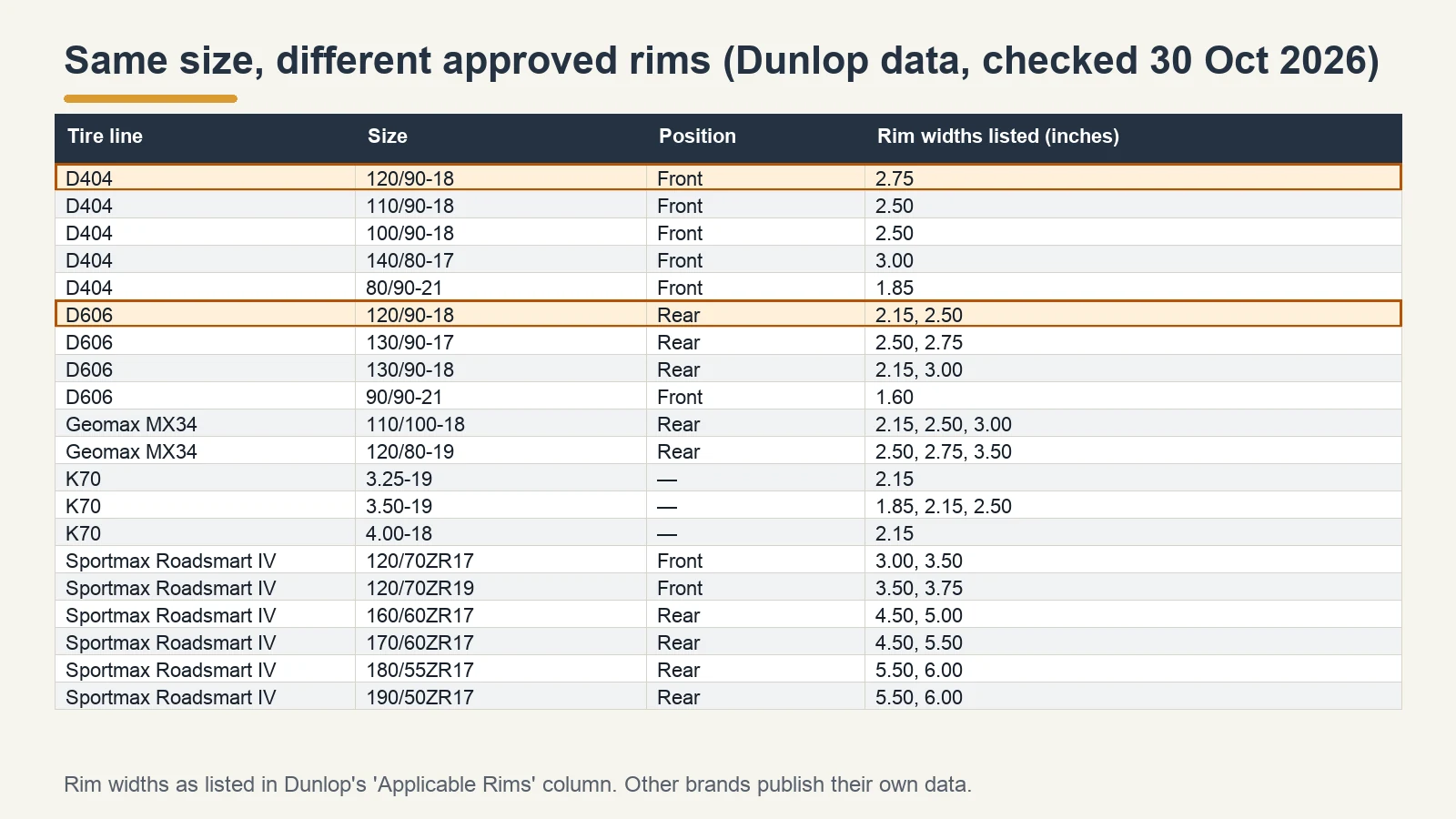
That's exactly why a single generic chart can't tell you what fits your wheel. These are one manufacturer's figures for specific products, not a universal rule, and other brands publish their own data for their own tires.
So what fits a 2.15-inch rim?
It's one of the most searched rim questions, and the honest answer is: whatever the tire maker lists 2.15 for, in the exact model you're buying. From the table above, Dunlop lists 2.15 among the rims for its D606 120/90-18 and 130/90-18 rears, the Geomax MX34 110/100-18, and several K70 sizes. That doesn't mean every 120/90-18 or every 110/100-18 on the market is approved for 2.15, as the D404 example shows.
The way to check:
- Find your rim width (stamped on the rim or in the owner's manual).
- Pick the tire model you want.
- Open the manufacturer's size table for that model and look for your rim width against your size.
- If it isn't listed, ask the manufacturer or choose a different tire.
Going wider: what the tire makers say
Dunlop's FAQ is direct about replacements in general: "The only sure way of doing this is to refer to the approved recommendations of a tire manufacturer or your motorcycle owner's manual."
On wider tires specifically, Dunlop says it's "possible in some cases, but again, it should only be done with the approval of the motorcycle or tire manufacturer." It lists what to think about: "clearance for width and diameter, the effect on stability and handling, along with whether your rim is wide enough." And it adds: "If wider tires are approved for a motorcycle, it is usually permissible to increase by only one size designation."
Michelin's FAQ takes a similar line on changing from the original dimensions: "We strongly recommend not to do so, unless an alternative size is validated by the vehicle manufacturer."
So rim width is one check, not the only one. A wider tire also needs room in the swingarm, fork and fender, and it can change how the bike steers.
A quick checklist before you buy
- Know your rim: width and diameter, from the rim stamp or the owner's manual.
- Start from the approved size: the owner's manual or the tire maker's fitment list for your bike.
- Check the exact model: look up your rim width against the size in that tire's own data.
- Check clearance: width and diameter, at the fork, swingarm, chain and fender.
- Stay within approvals: Dunlop says approved increases are usually only one size designation.
- Front and rear together: a big change at one end can affect how the bike handles. Follow the bike or tire maker's approved pairings.
To compare sizes side by side, try the tire size chart.
FAQ
What size tire fits a 2.15 rim?
It depends on the tire model. Tire makers approve rim widths per model and size. In Dunlop's data, for example, 2.15 is listed for the D606 120/90-18 and 130/90-18 rears and the Geomax MX34 110/100-18, but the D404 120/90-18 front lists 2.75. Check the data for the exact tire you're buying.
Is there a universal motorcycle rim width chart?
Not one you can rely on for every tire. Allowed rim widths vary by tire model, so the manufacturer's own size table is the reference. The official industry standards (ETRTO and JATMA) are published in paid manuals.
Can I put a wider tire on my stock rim?
Only with the approval of the motorcycle or tire manufacturer, according to Dunlop, and you need to check that your rim is wide enough and that there's clearance. Dunlop says approved increases are usually limited to one size designation.
What happens if a tire is too wide for the rim?
Use the tire maker's fitment data. Dunlop publishes the rim widths it lists for each model and size, and says wider-tire changes require manufacturer approval. If your rim isn't listed, ask the manufacturer or choose another tire.
Where do I find my rim width?
It's usually stamped on the rim (for example 2.15 × 18 or MT2.15 × 18) and listed in your owner's manual.
Sources
| Source | URL | Checked |
|---|---|---|
| Dunlop Motorcycle Tires, FAQ | https://www.dunlopmotorcycletires.com/about/faq | 20261030 |
| Dunlop, D404 (SPECS, Applicable Rims) | https://www.dunlopmotorcycletires.com/tire-line/d404/ | 20261030 |
| Dunlop, D606 (SPECS, Applicable Rims) | https://www.dunlopmotorcycletires.com/tire-line/d606/ | 20261030 |
| Dunlop, Geomax MX34 (SPECS, Applicable Rims) | https://www.dunlopmotorcycletires.com/tire-line/geomax-mx34/ | 20261030 |
| Dunlop, K70 (SPECS, Applicable Rims) | https://www.dunlopmotorcycletires.com/tire-line/k70/ | 20261030 |
| Dunlop, Sportmax Roadsmart IV (SPECS, Applicable Rims) | https://www.dunlopmotorcycletires.com/tire-line/sportmax-roadsmart-iv/ | 20261030 |
| Michelin Motorcycle, FAQ | https://www.michelinman.com/motorcycle/faq-motorcycle | 20261030 |
| ETRTO (Standards Manual is a paid publication) | https://www.etrto.org/ | 20261030 |