Fit a new tire, step back, and there it is: a small arrow moulded into the sidewall. Most guides mention it in one line: "make sure the arrow points the right way." But which way is right? Does a front tire point the same way as a rear? And what if the tire is already on the wheel and the arrow is pointing backwards?
Here's what tire makers actually say about the arrow, how to read it on your bike, and what to do if it's wrong.
What the arrow means
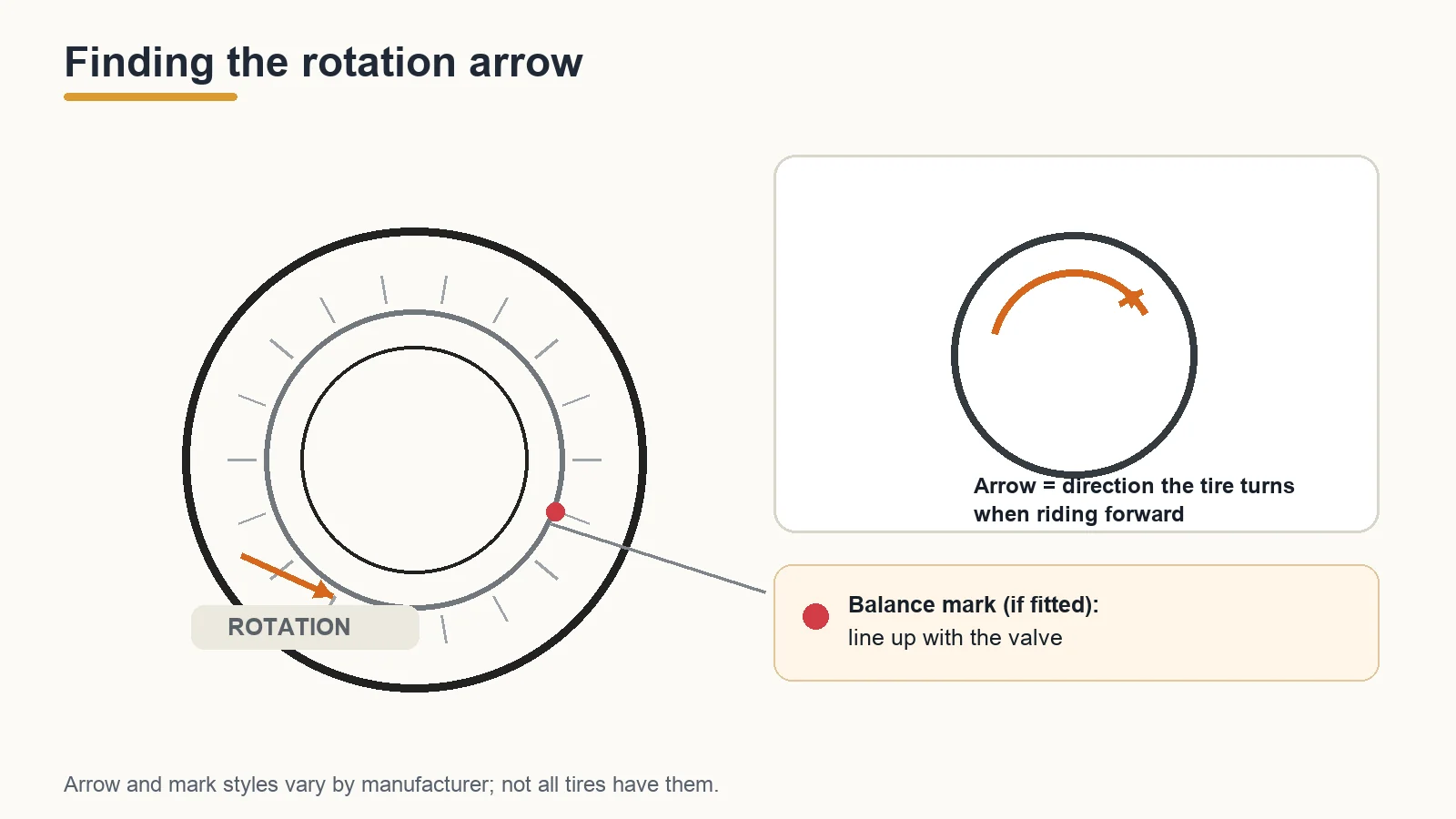
The arrow shows the direction of rotation: the way the tire should turn when the motorcycle is moving forward.
Dunlop puts it simply in its safety and care guidance: "All Dunlop street tires also have arrows on the sidewall, which indicate the correct direction of rotation."
Continental is just as clear, and adds why it matters: "Where a tire has directional arrows moulded upon it, the tire must be fitted so that the relevant front or rear arrow follows the direction of rotation. Road handling and tire wear may worsen, or damage to the tire can occur in extreme circumstances, if these instructions are not followed."
Note the words "where a tire has". Dunlop also says that "inclusion of directional arrows are not universal among motorcycle tire manufacturers." Not every tire has one. If yours does, follow it.
How to read it on the bike
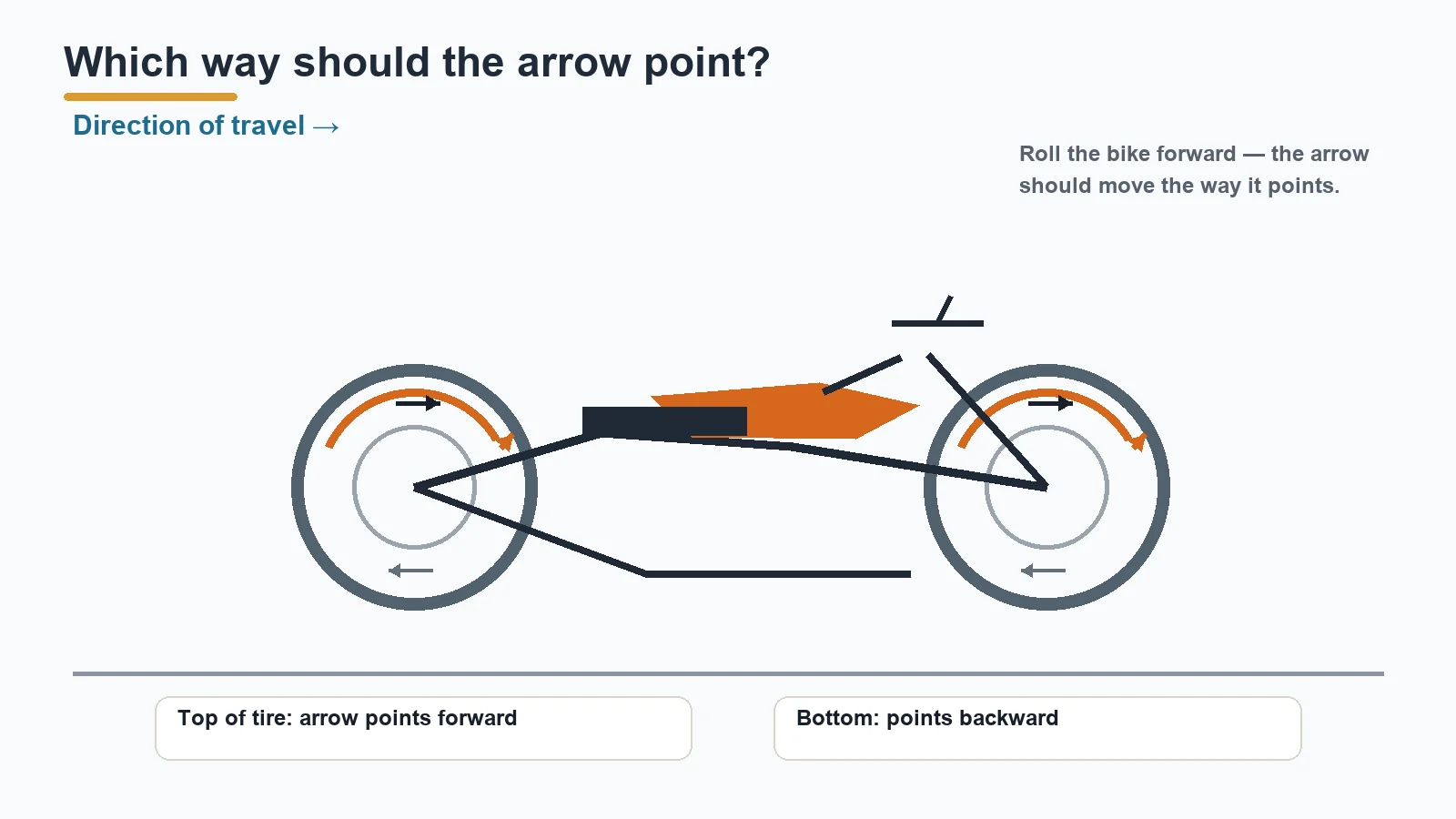
Picture the wheel turning as you ride forward: the top of the tire moves toward the front of the bike, and the bottom moves toward the back.
So with the wheel fitted and the bike facing forward:
- on the top half of the tire, the arrow should point toward the front of the bike
- on the bottom half, it should point toward the rear
The easiest check is to stand beside the bike, find the arrow, and roll the bike forward a little. The arrow should move in the direction it points.
Whichever side of the tire the arrow is on, the check is the same: at the top of the wheel, it points toward the front of the bike.
Front and rear tires can be different
Front and rear tires aren't interchangeable, and their tread patterns can face opposite ways.
Dunlop explains why in its FAQ: "Many Dunlop motorcycle tire patterns have 'reversed front patterns' compared to rear, because different forces act on front and rear tires." So if your front tread seems to point the "wrong" way compared with the rear, that may be exactly how it was designed. Go by the arrow, not by how the tread looks.
On fitment, Dunlop says: "Mount only tires marked 'front wheel' on the front position and only tires marked 'rear wheel' on the rear position." And in its FAQ: "Unless specially designed, you can only use a front on the front and a rear on the rear, following the directional rotation arrows."
Tires with two arrows
Continental's wording ("the relevant front or rear arrow") covers tires that carry more than one arrow, each labelled for a position. If you see two arrows pointing in opposite directions, use the one marked for the position the tire is going on, front or rear.
Why direction matters
The makers don't go into engineering detail, but they do say what's at stake:
- Wet performance. Dunlop says: "We test all Dunlop tires for satisfactory wet performance in the direction as indicated on the sidewall." A tire fitted backwards is running in a direction it wasn't tested for.
- Handling, wear and possible damage. Continental says that if the arrow isn't followed, "road handling and tire wear may worsen, or damage to the tire can occur in extreme circumstances."
That's enough to settle it. The tire was designed and tested to run one way.
What if the tire is mounted backwards?
It happens: a tire fitted in a hurry, a wheel put back the wrong way round after a puncture repair, or a used wheel bought with the tire already on it.
Neither manufacturer gives an allowance for riding on a backwards tire. Continental says the tire "must be fitted" so the arrow follows the direction of rotation, so the fix is to have it fitted correctly: break the bead, turn the tire round on the rim, and refit it so the arrow points the right way.
A few things to check while it's off:
- Balance mark. Dunlop street tires have "balance dots in the bead or sidewall area to indicate the lightest point of the tire" and should be installed "with these balance dots at the valve." Continental says that on its tires with a red dot, the dot "should be lined up with the valve stem in the rim during mounting." After turning the tire round, line the mark up with the valve again.
- Balance the wheel after refitting. Dunlop's guidance has a separate section on wheel balance.
- Tube-type wheels: Dunlop's mounting precautions include centring the rim band and tube "to prevent pinching."
If you do your own tire changes, our guide to replacing a motorcycle tire at home covers the process. If you'd rather not break the bead yourself, any tire shop can turn it round. Tell them why it's back so they check the balance mark too.
Quick checklist when fitting a new tire
- Check the tire is marked for the position you're fitting it to (front or rear).
- Find the arrow, and if there are two, the one labelled for that position.
- Fit it so the arrow points the way the wheel turns when riding forward.
- Line up the balance mark (if the tire has one) with the valve.
- Roll the bike forward and confirm the arrow moves the way it points.
Want to double-check the size while you're looking at the sidewall? Our guide to how motorcycle tire sizes work explains the numbers, and the tire size chart lists common sizes.
FAQ
Which way should the arrow on a motorcycle tire point?
In the direction the tire turns when you ride forward. On the top half of the wheel it points toward the front of the bike.
Does the front tire arrow point the same way as the rear?
Both arrows point in the direction of rotation, and both wheels turn the same way, so yes. The tread patterns may look reversed, though: Dunlop says many front patterns are reversed compared with the rear "because different forces act on front and rear tires."
What happens if a motorcycle tire is mounted backwards?
Continental says road handling and tire wear may worsen, or damage to the tire can occur in extreme circumstances. Have the tire turned round on the rim and refitted correctly.
Can I put a front tire on the rear?
Dunlop says that unless a tire is specially designed for it, "you can only use a front on the front and a rear on the rear."
Do all motorcycle tires have a rotation arrow?
No. Dunlop says directional arrows "are not universal among motorcycle tire manufacturers." If your tire has one, follow it.
Sources
| Source | URL | Checked |
|---|---|---|
| Dunlop Motorcycle Tires, Care & Maintenance (safety advisory, sections on tire installation and mounting) | https://www.dunlopmotorcycletires.com/about/care/ | 20261028 |
| Dunlop Motorcycle Tires, FAQs | https://www.dunlopmotorcycletires.com/about/faq/ | 20261028 |
| Continental, Motorcycle Tires FAQs (Directional arrows; Red dot on motorcycle tires) | https://www.continental-tires.com/tire-knowledge/motorcycle-tires-faqs/ | 20261028 |