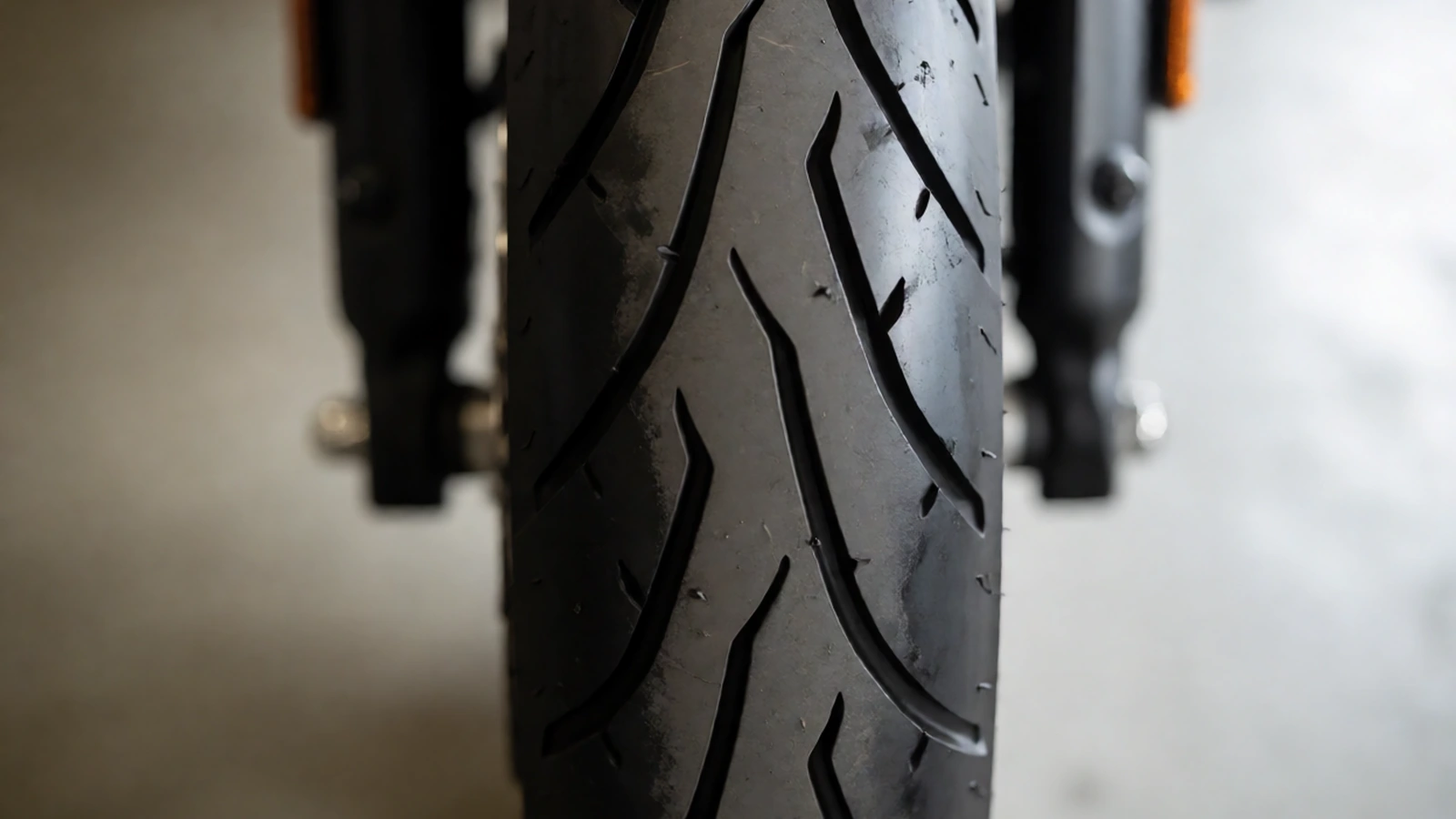
You've just picked the bike up from the shop with a fresh set of tires. They look great: shiny, sharp edges, full tread. And the first roundabout feels a bit vague. That's normal, and it's exactly why tire makers tell you to break new tires in.
The trouble is that advice online ranges from "ten minutes of weaving" to "500 miles". So instead of adding another opinion, here's what two manufacturers say on their own websites, side by side, plus what that means for your first ride.
Why new tires need breaking in
The two manufacturers give slightly different reasons, and both are worth knowing.
The film from the mould
Michelin explains that tires are shaped in moulds, and "when it comes to demoulding, it is necessary to use products that allow the tyre to be removed. As these products tend to leave a thin film of a shiny appearance on the tyre, it is important to take some precautions when riding until this film has completely gone."
That's the shine you see on a new tire, and it's why the first few corners can feel less planted than you expect.
A smooth surface that needs roughening
Continental focuses on the surface itself: "New tyres have a smooth, slippery surface that must first be roughened by moderate use. Maximum grip can only be ensured after the surface structure has been broken-in so the tyre can interlock with the rough surface of the road."
It adds a second reason that's easy to miss. Breaking in conditions the tire for the loads a powerful bike puts through it. In Continental's words, "It is easy to damage a modern high-performance tyre by mounting it and then immediately subjecting it to severe stress (especially high-speed riding)."
Either way, the conclusion is the same: the tire isn't giving you full grip on day one, and the way you ride the first stretch matters.
How long is the break-in? What each manufacturer says
| Manufacturer | Distance | Source wording |
|---|---|---|
| Michelin | At least 100 km (about 62 miles) | "We recommend at least 100 km for this process. This applies to all our motorcycle and scooter tyres." |
| Continental | About 150 km / 100 miles | "During the break-in period (approximately 150 km / 100 miles)…" |
So the honest answer to "how many miles?" is: somewhere around 100 km to 150 km, depending on whose tire you've fitted. Check the manufacturer of your own tires. If you can't find their guidance, the longer figure is the safer working assumption.
Distance alone isn't the whole story. Michelin points out that "depending on the ambient temperature, the break-in period can be shorter or longer." Warm weather gets the tire to its best grip sooner; cold weather takes longer.
How to ride during break-in
Both manufacturers describe the same basic approach: start gentle, build up gradually.
What to avoid
Continental is specific: during the break-in period, "heavy acceleration and braking, extreme lean angles and especially high-speed riding must be avoided."
Michelin's version for road riding: "Start slowly and use gentle acceleration and braking, as well as low lean angles. Gradually increase the demands on the tyres until you get used to their performance."
Where to ride
This is where the advice gets practical.
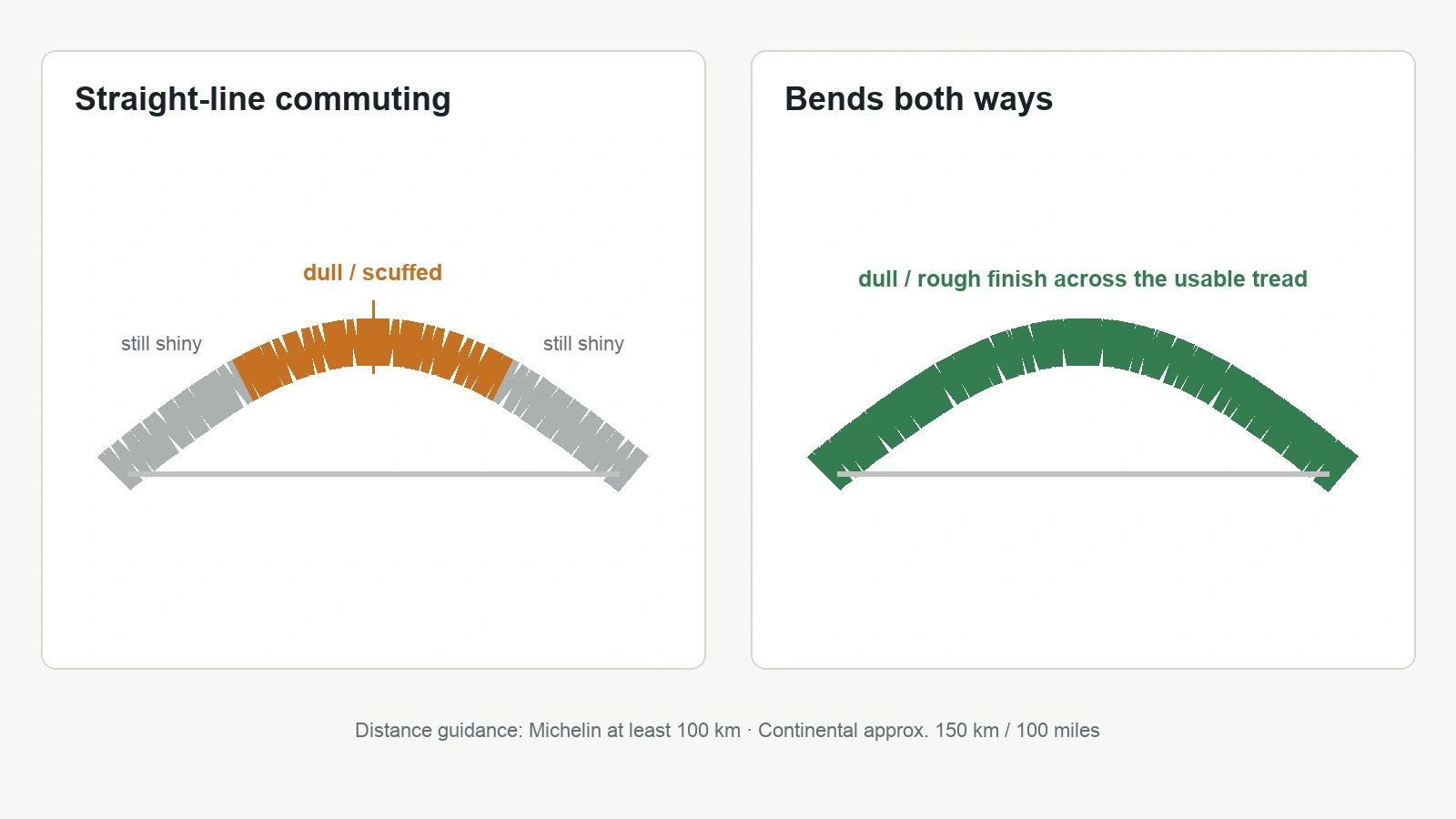
- Mix your roads. Michelin suggests a trip that covers at least the break-in distance "on all types of roads." The reason: daily commuting often loads one side of the tire more than the other. Their example is roundabouts, which always turn the same way. Break-in still happens on a commute, it just may take longer for both shoulders of the tire.
- Find some bends. Continental recommends "riding a twisty road and to start gently with low speed and lean angle and then slowly increase speed and acceleration until you develop a dull/rough finish across the usable tread surface."
That "dull/rough finish" is a useful visual check. A straight-line commute will scuff the centre of the tread and leave the shoulders shiny. The shoulders only break in when you lean onto them.
Little things that are easy to forget
- Peel off the labels. Continental: "Remove the tyre labels before riding."
- Check pressure. Set pressure to the figure the motorcycle manufacturer specifies for your model and load — check the owner's manual or the pressure label on the bike. Michelin stresses that correct pressure matters during the break-in period and throughout the tire's life.
- Warm up every ride, not just the first. Continental advises warming tires up "for every ride by gently braking, accelerating and cornering for the first few miles."
What not to do: shortcuts that can damage the tire
It's tempting to speed things up by scrubbing the tread. Michelin is direct about this: "do not use abrasive products to rub the surface of the tyre in the hope of removing the film more quickly. Doing so could cause irreversible damage to your tyre."
The only method either manufacturer recommends is riding.
Special cases
Changing only one tire
If you replace just the rear after a puncture, the new tire still needs breaking in. Michelin says "the break-in should be carried out with a new tyre in the same way as if you had changed both tyres." Expect the bike to feel uneven for a while: one worn-in tire and one new one.
Off-road
Michelin says break-in "may be faster than on the road due to the more frictional surfaces involved," but still recommends keeping to the 100 km target before putting more strain on new tires.
Track days
Michelin's track advice depends on warmers. With tire warmers, keep the temperature up with enough load from the start. Without them, follow the same gentle start as on the road.
How do you know you're done?
There's no light on the dash for this. Use three signals together:
- Distance: at least the figure your tire maker gives (100 km for Michelin, around 150 km / 100 miles for Continental).
- Look: the shine has gone and the tread has a dull, slightly rough finish across the area you actually use, including the shoulders. Michelin says that "as long as the thin film is present on your new tyre, the break-in process is not complete."
- Feel: the tire feels predictable at the lean angles you normally ride.
Then build up to your usual pace progressively, not all at once.
If you're still choosing what to fit next time, our guide on how to choose motorcycle tires covers the main checks, and how often to replace motorcycle tires and when to change motorcycle tires help you plan the next change. To confirm a size before buying, try the tire size calculator or the motorcycle tire size chart.
FAQ
How many miles does it take to break in new motorcycle tires?
Michelin recommends at least 100 km (about 62 miles); Continental says about 150 km / 100 miles. Follow the guidance from your own tire's manufacturer, and allow longer in cold weather.
Why are new motorcycle tires slippery?
Michelin says the products used to release tires from the mould leave a thin shiny film. Continental describes a smooth surface that has to be roughened by riding before the tire can fully key into the road.
Can I scrub new tires with sandpaper or a solvent to speed up break-in?
Michelin advises against using abrasive products on the tread, warning it "could cause irreversible damage." Riding is the only method it recommends.
Do I need to break in a tire if I only replaced one?
Yes. Michelin says to break in a single new tire the same way as a full set.
Does commuting break in new tires?
Yes, but it can take longer. Commutes often load one side of the tire more than the other, so the shoulders may stay shiny. A ride with bends in both directions finishes the job more evenly.
Sources
| Source | URL | Checked |
|---|---|---|
| Michelin New Zealand, "Breaking in new motorcycle tyres" | https://www.michelin.co.nz/motorbike/advice-motorbike/tyre-care/breaking-in-new-motorcycle-tyres | 20261026 |
| Continental Australia, "Breaking in new motorcycle and scooter tyres" | https://www.continental-tires.com/au/en/tyre-knowledge/braking-in-new-motorcycle-tyres/ | 20261026 |